
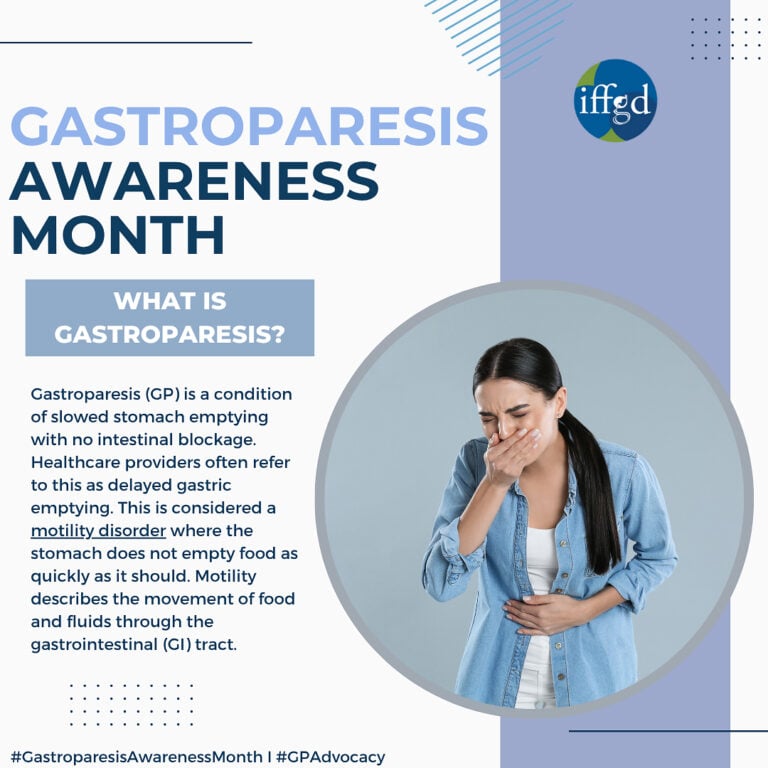
August is Gastroparesis Awareness Month. IFFGD works to focus attention on important health messages about gastroparesis diagnosis, treatment, and quality of life issues. The goals include improving understanding of gastroparesis to help patients and families manage the condition, and encouraging preventive strategies.
Our 2026 #MoreThanInvisible Campaign
Although the illness is largely invisible, its impact is anything but. People living with gastroparesis may experience persistent nausea, vomiting, abdominal pain, bloating, early fullness after eating only a few bites, reflux, regurgitation, unintended weight loss, and malnutrition. Symptoms often occur during or after meals and can significantly affect nutrition, employment, emotional well-being, and overall quality of life.
The “More Than Invisible” campaign aims to remind communities that while a person with gastroparesis may not appear ill, they are often managing a complex medical condition every day. Beyond the physical symptoms, many individuals face anxiety, depression, social isolation, and the challenges of planning daily activities around unpredictable symptoms and dietary restrictions.
Throughout Gastroparesis Awareness Month, IFFGD will share educational resources, patient stories, expert interviews, downloadable fact sheets, and social media content to increase awareness and encourage meaningful conversations about the condition. The campaign also seeks to help patients recognize symptoms earlier and encourage healthcare providers to consider gastroparesis when evaluating individuals with persistent upper gastrointestinal symptoms.
Here are a few things you can do to help educate yourself and others and raise awareness for gastroparesis in your community:
- Download the 2026 Gastroparesis Awareness Month Media Toolkit here.
- View our 2026 Gastroparesis Awareness Month Press Release.
- Check out these commonly asked questions about gastroparesis.
- Check out these tips on preventive and management strategies.
- Download and share our free introductory packet on gastroparesis to help others learn about the condition.
- Go to our IFFGD web site to share your experiences or find other resources to work with others to create meaningful, positive change on behalf of everyone affected by gastroparesis.
- Find IFFGD on Facebook and Twitter and join the conversation.
With sponsorship by IFFGD, Gastroparesis Awareness Month was listed on the U.S. National Health Observances Calendar* beginning in 2016. Health observances are days, weeks, or months devoted to promoting particular health concerns. Individuals, health professionals, teachers, community groups, and others can use these special times to sponsor health promotion events and stimulate awareness of health issues.
We encourage people experiencing the symptoms of gastroparesis to consult their physicians and to browse our web pages or contact us to receive information regarding the condition.
Background
The number of people with gastroparesis appears to be rising. Yet gastroparesis is poorly understood. More community awareness is needed about the condition.
The more we work together to raise awareness for gastroparesis, the greater our ability to impact positive outcomes, such as additional research and improved patient care for the functional GI and motility disorders community.
Statement for the Record for
Gastroparesis Awareness Month
On July 12, 2016 U.S. Senator Tammy Baldwin (WI) introduced a statement for the record on behalf of the millions of Americans affected by gastroparesis recognizing National Gastroparesis Awareness Month. Read her remarks here.
Gastroparesis Awareness Month Honored
On July 9, 2015 Congresswoman Gwen Moore (WI-4) introduced a statement in the US House of Representatives on behalf of Americans affected by gastroparesis in honor of National Gastroparesis Awareness Month. Read her remarks here.
Remember, if you have questions specific to a personal health problem, condition, or treatment, talk with your physician or healthcare provider – one who is familiar with and can address your individual circumstances.
*The National Health Observances Calendar was maintained by the U.S. Department of Health and Human Services, Office of Disease Prevention and Health Promotion. These events are now archived